
Courses
G.D.C. & A. Exam 2026
Empowering the Co-operative Movement through Professional Education
Organized by: Mr. Vijay Sawdekar, Course Director, MahaSeWA
About the G.D.C. & A. Examination
The Government Diploma in Co-operation and Accountancy (G.D.C. & A.) is one of Maharashtra’s most respected qualifications for professionals aspiring to build a career in the co-operative sector. Conducted by the G.D.C. & A. Board, Department of Co-operation, Government of Maharashtra, the diploma aims to create a cadre of knowledgeable, efficient, and ethically driven professionals capable of managing co-operative societies across the State.
With the growing significance of Housing Societies, Credit Co-operatives, Urban Co-operative Banks, and Agricultural Institutions, there is a continuous demand for trained professionals who understand both practical operations and statutory compliance. Recognizing this need, MahaSeWA, under the mentorship of CA Ramesh Prabhu (Chairman, MahaSeWA) and guidance of Mr. Vijay Sawdekar, has taken the initiative to train and guide candidates for outstanding performance in this prestigious examination.
Vision & Objectives
- Prepare qualified professionals to handle administrative, accounting, and auditing functions of co-operative institutions.
- Promote standardization, transparency, and accountability in the functioning of co-operatives.
- Develop skilled manpower for Housing Societies, Credit Societies, and Co-operative Banks.
- Create career advancement and self-employment opportunities within the co-operative sector.
Examination Details
| Particulars | Details (for more info visit gdca.maharashtra.gov.in) |
|---|---|
| Name of Diploma | Government Diploma in Co-operation and Accountancy (G.D.C. & A.) |
| Conducted by | G.D.C. & A. Board, Pune |
| Under | Department of Co-operation, Government of Maharashtra |
| Frequency | Once every year (usually in the last week of May) |
| Application Period | January–February |
| Exam Mode | Offline (Written) |
| Exam Duration | 3 days – two papers per day |
| Exam Fee | ₹ 800 |
| Medium | English or Marathi |
| Centres | Multiple districts across Maharashtra |
Subjects & Marks Distribution
| Subject | Marks |
|---|---|
| Management of Co-operative Housing Societies | 100 |
| Accounts | 100 |
| Auditing | 100 |
| History, Principles & Management in Co-operation | 100 |
| Co-operative Laws & Allied Laws | 100 |
| Co-operative Banking & Credit Societies | 100 |
| Total | 600 Marks |
Eligibility Criteria
- Graduate in any discipline from a recognized University.
- S.S.C. pass with at least five years' experience in a Government Co-operation Department or any registered Co-operative Organization.
Duration & Course Structure
- Course Duration: 4 months (approx.)
- Lecture Mode: Pre-recorded video lectures + live sessions
- Mode of Learning: Hybrid (Online + Offline)
- Study Material: Notes, question banks, past papers, assignments, mock tests
- Course Fee: As prescribed by the institute
Documents Required for Admission
- Graduation Marks Sheet / Provisional Certificate
- Photo ID Proof (Aadhaar / Voter ID / Passport)
- Passport-size Photograph
- Signature (for registration)
- Proof of Date of Birth (Leaving Certificate)
- Mother's Name (mandatory)
- Proof of Name Change (for married women – Gazette / Marriage Certificate)
Career Opportunities After G.D.C. & A.
- ✅ Certified Auditor – Eligible for empanelment as a Co-operative Auditor after 3 years of practical experience.
- ✅ Society Manager – Appointed full-time or part-time with recognized credentials.
- ✅ Consultant / Advisor – Independent practice in Co-operative Consulting, Taxation, or Auditing.
- ✅ Accountant / Internal Auditor – Employment in Co-operative Banks, Credit Societies, or Federations.
- ✅ Government & Institutional Promotions – Preference and advancement benefits for G.D.C. & A. qualified employees.
Coaching & Guidance by MahaSeWA and Mr. Vijay Sawdekar
- Expert faculty with practical co-operative experience
- Updated syllabus with simplified study material
- Regular revision & mock test sessions
- Access to circulars, bye-laws, and case studies
- Personal guidance for registration and documentation
- Doubt-solving and live Q&A sessions (2 per month)
- Offline interaction sessions in Mumbai & Pune (2–3 sessions total)
- Mode of Learning: Online + Offline (Hybrid)
Frequently Asked Questions (FAQs)
- When is the GDCA (marathi)Exam conducted? Usually in the last week of May each year.
- Where can I fill the exam form? Online at gdca.maharashtra.gov.in.
- What is the exam fee? ₹ 800.
- What is the medium of the exam? English or Marathi.
- What are the eligibility criteria? Graduate in commerce/related field OR working in a co-operative institution with required service (HSC + 3 years or SSC + 5 years).
- How can I become a Certified Auditor after GDCA? Complete the diploma and gain 3 years practical experience.
- What if I have doubts during preparation? Contact MahaSeWA support or attend doubt-solving sessions.
- How many papers and exam pattern? Two papers: Paper 1 (Theory), Paper 2 (Practical / Case studies).
- When are results declared? On the official GDCA (marathi)website, usually January/February.
- Documents required for online application? Scanned photo (3.5 cm × 4.5 cm), scanned signature (3.5 cm × 1.5 cm), JPEG format, file size < 50 KB.
Syllabus
Paper 1 — Management of Cooperative Housing Societies
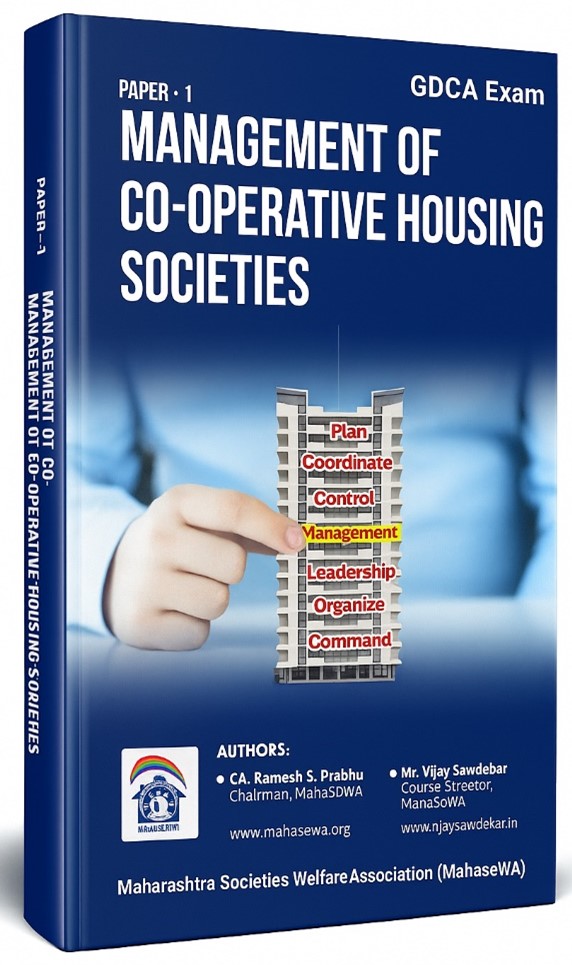
- History and Movement of Co-operative Societies
- Co-operative Housing Societies - concept, Definitions, objects, Functions of Housing societies
- Maharashtra Ownership Flat Act, 1963
- Maharashtra Apartment Ownership Flat Act, 1970
- Types of Housing societies and their respective functions
- Registration of Co-operative Housing Societies
- Salient features of Model Housing societies' Bye-laws
- Members, their rights, responsibilities and liabilities
- Elections to managing committee of Housing societies
- Management of the affairs of the society
- Maintenance of Account Books and Registers
- Execution of conveyance deed in Housing societies
- Statutory actions and provisions under M.C.S. Act 1960 and M.C.S Rules 1961 related to housing societies. Duties and powers of the general body and managing committee
- Obligations of the members in Housing societies e.g. (a) Maintenance and repair (b) Use of common areas and facilities and restricted common areas and facilities
- Problems and Disputes in Housing societies and the remedies e.g. (a) General Body, (b) Registrar, (c) Coop court, (d) Municipal corporation, (e) Police authorities, (f) Civil and other courts
- Funds, their utilization and investment
- Redevelopment of Housing societies
- Co-operative Housing Society Manual
- Audit of Housing Co-operative societies and their need and importance
Paper 2 — Accounts
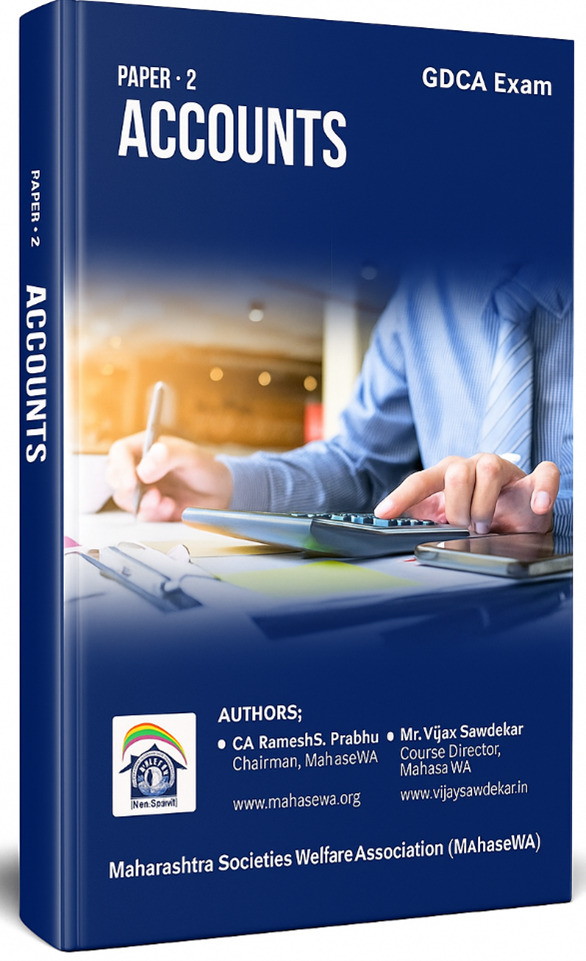
- Accounting Principles and Rectification of Errors
- Final Accounts
- Bills of Exchange
- Books of Accounts
- Depreciation
- Branch Accounts and Reconciliation
- Reserves and Divisible Profits
- Valuation and Verification of Assets and Liabilities
- Revaluation of Fixed Assets
- Amalgamation Accounts
- Liquidation Accounts
- Accounting Ratios
- Cash Flow and Funds Flow Statements
- Accounting Standards (AS 1 to AS 29, excluding AS 8)
- Introduction to Computerized Accounting
- Introduction to Cost Accounting
- Introduction to Management Accounting
- Social Balance Sheet
Paper 3 — Auditing
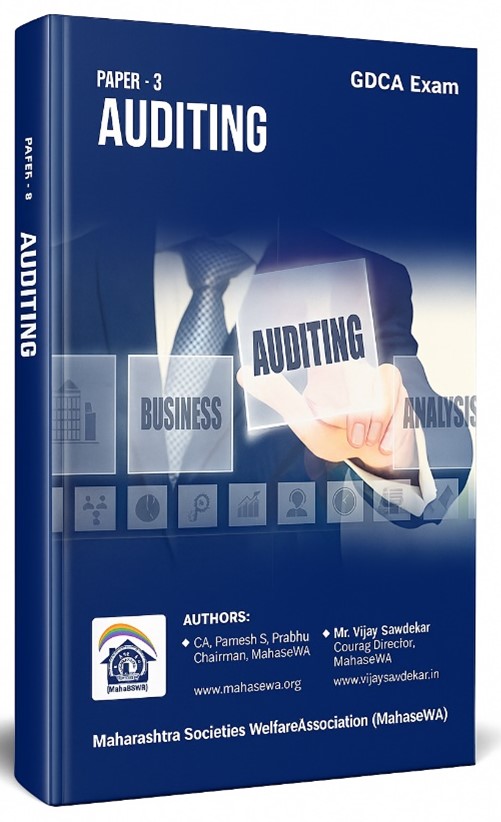
- Audit Concepts, Scope, and Types in Co-operatives
- Internal Control, Checks, and Auditor's Duties
- Audit Preparation, Programme, and Working Papers
- Vouching Vouchers, Fraud, and Error Detection
- Capital and Revenue Expenditure Overview
- Vouching Trading Transactions and Journal Auditing
- Asset and Liability Valuation and Verification
- Standard Auditing Policies by ICAI
- Depreciation Methods and Applications
- Reserves and Provisions in Co-operatives
- Special Considerations in Co-operative Auditing
- Audit of Government-Aided Co-operatives
- Roles, Responsibilities, and Powers of Auditor
- Co-operative Societies Act Audit Provisions
- Co-operative Societies Audit Reports
- Special Reports – Administrative
- Management, Special, and Cost Audit Overview
- Audit Practices in Computerized Environment
Paper 4 — History, Principles and Management in Co-Operation
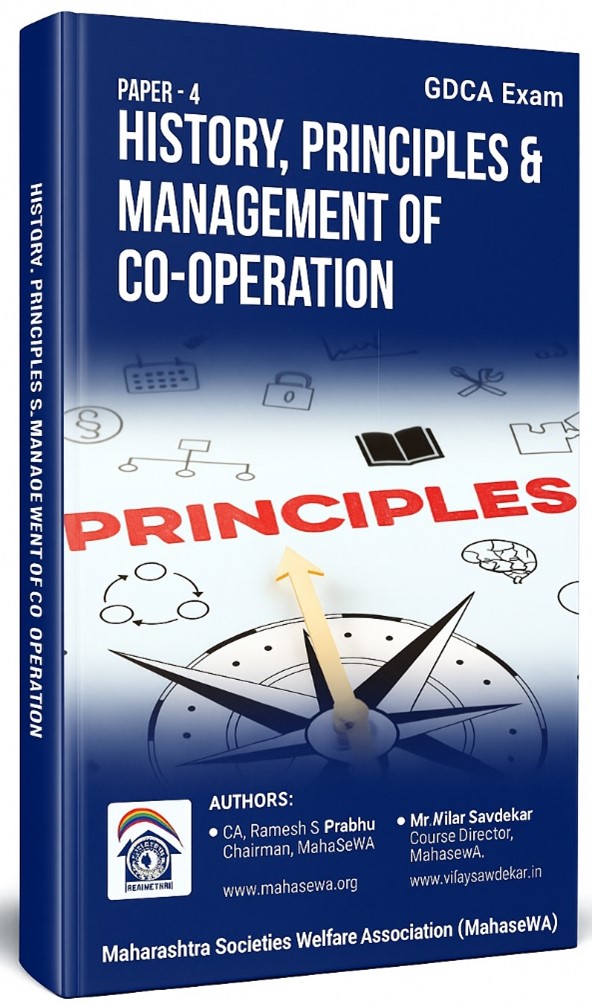
- Historical Development and Evolution of the Co-operative Movement – Pre and Post-Independence
- Progress and Expansion of the Co-operative Movement in Maharashtra
- Concept and Principles of Co-operation
- Historical Background and Importance of State and Multi-State Co-operative Legislations
- Future Prospects of the Co-operative Movement in a Liberalized Economy and the Digital Era
- Major Committees Appointed to Study and Review the Co-operative Sector
- Co-operative Education, Training, and Research Initiatives
- Organizational Structure of Co-operative Departments
- Audit of Co-operative Societies
- Contribution of Institutions to the Development of the Co-operative Movement, Agricultural Sector, and Marketing
Paper 5 — Co-operative Law and other Laws
Part I
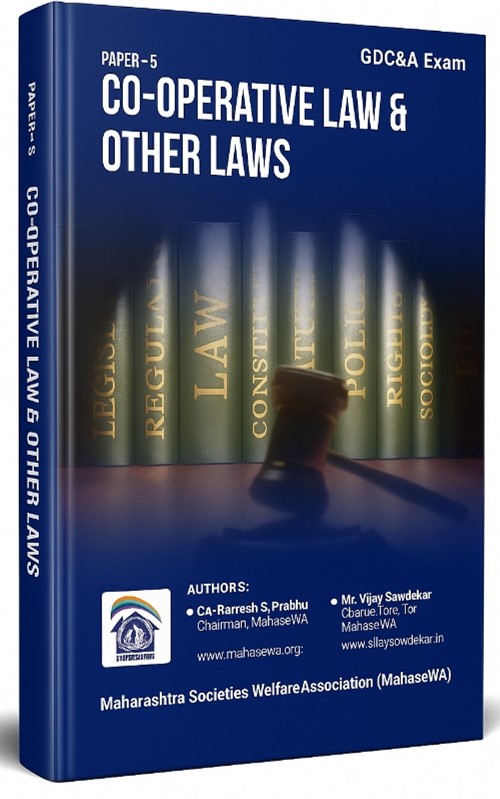
- Formation and Registration of Co-operative Societies
- Management and Governance of Co-operatives
- Government Support and Regulatory Framework
- Reorganization and Structural Changes
- Financial Control and Audit Mechanism with (Section 81 and 82)
- Disciplinary Action and Legal Control
- Grievance Redressal and Legal Remedies
- Liquidation and Winding Up of Societies
- Overview and Key Features of M.C.S. ACT, 1960
- Salient Features of the Multi-State Cooperative Societies Act, 1984/2002 and the Rules Framed Thereunder
Paper 6 — Co-operative Banking and Credit Societies
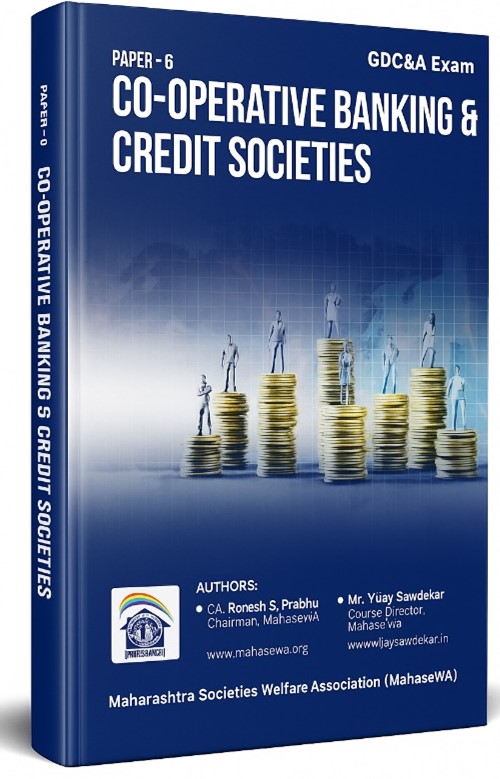
- Concepts, Definitions, and Core Functions of Banking
- Distinctive Characteristics of Co-operative Banking
- Co-operative Banking in Agricultural and Non-Agricultural Fields
- Banks for Salary Earners, Urban Co-operative Banks (UCB), and Regional Rural Banks (RRB)
- Instruments of Negotiation in Banking
- Relationship Between Banker and Customer
- Clearing House Operations and Mutual Settlement Schemes
- Impact of Recent Economic and Financial Reforms on Co-operative Banking
- Integration of Banking with Information Technology
- Structure and Operations of Apex Financial Institutions – MSCB, DCCB, NHB, and MASCARD
- Reserve Bank of India – Functions and the Role of NABARD
- Provisions of the Reserve Bank of India Act, 1934
- Provisions of the Banking Regulation Act, 1949 Relating to Co-operative Societies
- RBI Guidelines for Establishing Urban Co-operative Banks
- Role of the Deposit Insurance and Credit Guarantee Corporation (DICGC)
- Administration of Loans and Advances
- Loan Recovery Processes in Urban Co-operative Banks
- Recognition of Income and Classification of Non-Performing Assets (NPAs)
- Functioning of Co-operative Credit Societies
- Procedures for Auditing Co-operative Credit Societies
GDCA Exam – Frequently Asked Questions
Answers to common questions about the GDCA Course and Exam
1. What exactly is the GDCA Course?
Ans: The Government Diploma in Co-operation & Accountancy (G.D.C. & A.) is a professional qualification designed to train individuals in Co-operative Law, Accounts, Audit, and Management. It is a mandatory qualification for those who wish to work as auditors, consultants, or managers in the co-operative sector.
2. When does the GDCA (marathi)exam usually take place?
Ans: The examination is generally conducted once a year, most commonly in the month of May, as scheduled by the Maharashtra State Co-operative Department.
3. How can a student check the latest updates about the exam?
Ans:All official notifications, timetables, syllabus, and circulars are released on the official websites:
• gdca.maharashtra.gov.in
• sahakarayukta.maharashtra.gov.in
4. What is the basic eligibility to apply for the GDCA (marathi)Exam?
Ans: You are eligible if you meet any one of the following:
• A graduate from any recognized University, OR
• SSC (10th pass) with a minimum of 5 years’ experience in the Co-operative Department or any Co-operative Organisation/Society/Institution.
• HSC (12th pass) with a minimum of 3 years’ experience in the Co-operative Department or any Co-operative Organisation/Society/Institution
5. How can I fill the GDCA (marathi)exam application form?
Ans: The form is to be filled online only on the official GDCA (marathi)website during the registration period announced by the board.
6. What is the fee for the examination?
Ans: The examination fee prescribed by the G.D.C. & A. Board, Pune is Rs. 800/- (subject to revision as per government rules).
7. How many subjects are there in the GDCA (marathi)Exam?
Ans: The exam consists of multiple papers covering:
1. Management of Co-operative Housing Societies
2. Accounts
3. Auditing
4. History, Principles and Management in Co-Operation
5. Co-operative Law and Other Laws
6. History, Principles and Management in Co-Operation
8. What is the pattern or schedule of the exam?
Ans: The exam is usually conducted over three consecutive days—Saturday, Sunday, and Monday, with two papers per day.
9. In which language can a student write the exam?
Ans: Students have the option to write the exam in English or Marathi.
10. What career benefits do students get after completing the GDCA (marathi)Course?
Ans: After passing GDCA, candidates can:
• Work as Society Manager (Full-time/Part-time)
• Work as Internal Auditor / Panel Auditor
• Become Independent Consultant for Co-operative Housing / Premises Societies
• Secure job promotions in Co-operative Banks, Credit Societies, Federations etc.
• Maintain accounts for co-operative organizations
• Start an independent professional practice
11. What documents are required for exam registration?
Ans: Typically required documents include:
• Graduation Certificate or SSC + Experience Certificate
• Photo & Signature
• Aadhaar Card
• Employment/Service certificate (if applicable)
12. How does your GDCA (marathi)Coaching Institute support students?
Ans: Our institute provides:
• Expert faculty from the co-operative field
• Updated notes, books, and question banks
• Previous year solved papers
• Practical training on accounts & audit
• Chapter wise assignments, revision lectures & doubt-solving sessions
• Guidance for exam form filling and career opportunities
13. Do you provide study material for self-study students?
Ans: Absolutely. Students can purchase GDCA (marathi)Notes, Updated Books, Question Papers, Assignments and Model Tests separately.
14. How can students clear remaining doubts or get personal guidance?
Ans: You can contact us directly for GDCA (marathi)classes, notes, test series, and paper solutions at:
📞 9082909576 / 9029279080
www.vijaysawdekar.in / www.mahasewa.org